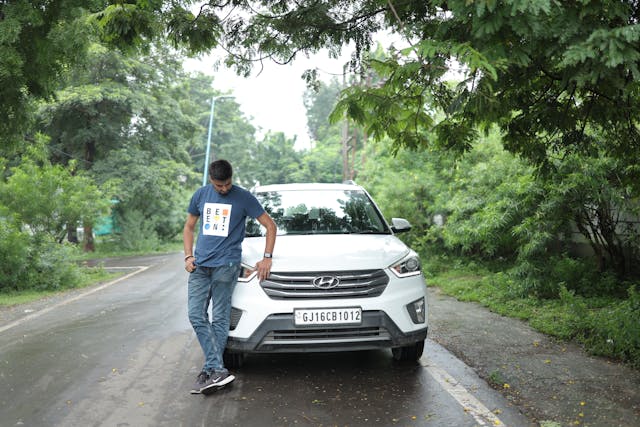
The Hyundai Creta ground clearance is 190 mm — confirmed across all variants in Hyundai India’s official specifications. That single number has quietly become one of the most searched figures among Creta buyers, and for good reason: on Indian roads, where speed breakers vary wildly in height and monsoon-flooded stretches are a reality in most cities, ground clearance is not a spec-sheet detail. It is the difference between a smooth drive and a scraped underbody.
This article covers every key dimension and mechanical specification of the Hyundai Creta in one place: ground clearance, full dimensions in mm and feet, tyre size and pressure, horsepower across all three engines, fuel tank capacity, engine oil capacity, kerb weight, and seating. Whether you are buying, maintaining, or comparing, you will find every number you actually need here.
Most spec guides either focus only on ground clearance or list raw numbers without any context about what they mean for real-world driving. This article does both — every figure is given with enough explanation to help you decide whether the Creta suits your specific use case, whether that is daily city commuting, highway touring, or the occasional rough village road.
Hyundai Creta Ground Clearance: What 190 mm Actually Means
The Hyundai Creta ground clearance of 190 mm is measured in the unladen state — meaning no passengers, no luggage. Once you load four adults and weekend bags, the effective clearance drops slightly due to suspension compression, typically landing around 170–175 mm under full load. That is still comfortable for most Indian urban infrastructure.
To put 190 mm in perspective: a standard speed breaker in India measures between 100 mm and 120 mm in height according to IRC (Indian Roads Congress) guidelines. The Creta clears these with roughly 70–90 mm to spare. Where you will feel the limits is on abnormally tall or poorly constructed breakers — the kind common outside schools and hospitals in smaller cities — and on steep entry ramps into parking basements.
Compared to key rivals, the Creta holds its own but does not lead. The Kia Seltos shares an identical 190 mm figure. The Tata Harrier sits higher at 205 mm, while the Maruti Grand Vitara comes in at 210 mm. The Honda Elevate matches Creta at 190 mm. If your primary concern is off-road clearance or you regularly navigate deeply flooded streets during monsoon, the Harrier or Grand Vitara have a measurable edge. For typical urban and highway use, 190 mm is more than adequate.
Quick Note: Always check ground clearance with the car unladen. Manufacturer figures are measured without passengers or cargo. Under full load, your actual clearance will be 10–20 mm less depending on variant and suspension stiffness.
Hyundai Creta Dimensions in Feet and Millimetres
The current-generation Creta (2024 onwards) measures 4,330 mm in length — approximately 14.2 feet. The width is 1,790 mm (5.87 feet) and height is 1,635 mm (5.36 feet). The wheelbase stands at 2,610 mm (8.56 feet). These are the figures for the 2024-generation facelift; earlier 2020–2023 models measured 4,300 mm in length.
For practical reference: a standard apartment parking bay in Indian residential complexes is typically 2,400–2,500 mm wide and 5,000 mm long. The Creta’s 1,790 mm width fits comfortably, and the 4,330 mm length leaves usable space at both ends. It is one of the more manageable SUVs to park in tight urban conditions, which partially explains its consistent popularity in metro cities. If you are comparing variants and want to explore how the SX and SX(O) differ in features beyond dimensions, the guide to Creta SX, Knight and N Line configurations breaks that down in detail.
The Hyundai Creta height in feet — 5.36 feet — is worth noting for drivers who use multi-level car parks or covered parking with height restrictions. Most urban parking structures in India have a minimum clearance of 2,000 mm (6.5 feet), so the Creta passes with room to spare. The roof rails available on higher trims add roughly 40 mm, bringing the total to approximately 1,675 mm — still comfortably under any standard height barrier.
Hyundai Creta Tyre Size and Tyre Pressure by Variant
The Creta runs two different tyre sizes depending on trim level. Base variants (E and EX) use 205/65 R16 tyres, while higher trims from S upwards use 215/60 R17 tyres. The number codes describe the tyre’s cross-section width in mm, the aspect ratio (sidewall height as a percentage of width), and the rim diameter in inches.
The 205/65 R16 setup on base variants prioritises comfort and a taller sidewall, which absorbs road imperfections well — particularly relevant on poorly surfaced state highways. The 215/60 R17 on top variants offers a slightly wider contact patch and better lateral grip, which you notice in faster cornering on smooth roads. The trade-off is a firmer ride on broken surfaces and marginally higher replacement costs when it’s time to change rubber.
For Hyundai Creta tyre pressure, the manufacturer-recommended figure for normal loads (up to three occupants with minimal luggage) is 33 PSI across all four tyres. When fully loaded — five adults plus luggage — raise this to 35 PSI. Always check pressure cold, meaning the car has been rested for at least two hours. A warm tyre will read 2–4 PSI higher than actual cold pressure, which can lead to under-inflation decisions and faster tread wear. According to Cars24’s tyre pressure guide for Hyundai models, checking at the driver’s door jamb sticker confirms the manufacturer’s recommended figures specific to your variant.
Hyundai Creta Horsepower, Engine Options and Tank Capacity
The Creta is available with three distinct engine options in India, and the horsepower figure differs significantly between them. The 1.5-litre naturally aspirated petrol produces 115 PS (approximately 113 bhp), paired with either a 6-speed manual or CVT automatic. The 1.5-litre turbocharged diesel generates 116 PS but with considerably more torque — 250 Nm — which is why diesel Creta owners report noticeably better overtaking performance on highways with less throttle effort.
The performance option is the 1.5-litre turbo petrol, available on the top-spec SX(O) variant, which produces 160 PS and 253 Nm, paired exclusively with a 7-speed DCT automatic. According to V3Cars’ engine specification data, this turbo petrol variant reaches 100 km/h in under 9 seconds — substantially quicker than the naturally aspirated version. If performance matters to you alongside daily practicality, this is the engine to consider, though it commands a significant price premium over the base petrol. For a full breakdown of what each variant costs across cities, the comparison of Creta on-road prices across 9 Indian cities gives you city-by-city numbers including insurance and registration.
The Hyundai Creta fuel tank capacity is 50 litres across all variants and engine options — Hyundai does not differentiate by powertrain here. Combined with the diesel engine’s claimed mileage of 18.4 kmpl (ARAI), you get a theoretical range of approximately 920 km per tank. Real-world figures are lower — most diesel Creta owners report 15–16 kmpl on highways and 12–13 kmpl in city traffic — giving a practical range of 750–800 km between fills.
Hyundai Creta Engine Oil Capacity, Kerb Weight and Other Specs
The engine oil capacity for the current-generation Creta (2024 model) is 4.8 litres for the petrol variants. The recommended grade is SAE 5W-30, meeting ACEA A3/B4 standards. If your mechanic fills less than 4.5 litres during a service, it is worth querying — underfilling by even half a litre over multiple service cycles can affect oil pressure at high engine speeds. The older 2020–2023 Creta used a slightly different specification with 3.6 litres for the naturally aspirated petrol engine, so the capacity did increase with the generation change.
The Hyundai Creta kerb weight ranges between 1,210 kg and 1,590 kg depending on variant and powertrain. The lighter end of that range represents the base petrol manual; the heavier end reflects top-spec turbo petrol or diesel automatics with additional features and equipment. Kerb weight matters practically for two reasons: heavier vehicles consume slightly more fuel in stop-start traffic, and they place greater stress on tyres over time. The weight difference between the lightest and heaviest variant — nearly 380 kg — is worth factoring in if fuel efficiency is your top priority.
The Hyundai Creta seating capacity is five in all current India-market variants. There is no seven-seat version of the Creta sold in India — that larger format is covered by the Hyundai Alcazar, which shares the Creta’s platform but stretches it to accommodate a third row. If seating capacity of 7 is a requirement for your family, the Alcazar is the natural upgrade path. Before making that decision, it helps to understand the Creta’s full price range first — check the Creta price guide covering Bhubaneswar, Jaipur and more cities to see on-road costs in your region.
Our take: Among the three engine options, the 1.5-litre diesel manual is the most practical choice for buyers who cover more than 1,500 km per month. The fuel savings over a 3-year period more than offset the higher purchase price, and the 250 Nm torque makes it effortless on expressways without needing high revs. The turbo petrol is genuinely enjoyable to drive but makes financial sense only if you prioritise the driving experience over economy. The naturally aspirated petrol is the value pick for light urban use.
How the Creta’s Specs Compare to Key Rivals
The compact SUV segment in India is fiercely contested, and the Creta’s numbers sit in the middle of the pack rather than at the extremes. The Kia Seltos — built on the same platform — shares virtually identical dimensions and ground clearance but offers a wider engine lineup including a 1.5-litre turbo petrol with 160 PS in the higher-spec HTX+ and GTX+ trims. The primary difference between the two comes down to feature packaging and dealer network, not fundamentals.
The Tata Nexon, a frequent Creta alternative in the ₹10–14 lakh bracket, measures 3,993 mm in length — 337 mm shorter than the current Creta. That shorter footprint makes the Nexon easier to manoeuvre in dense city traffic but noticeably smaller inside, particularly for rear passengers on longer journeys. The Nexon’s ground clearance of 208 mm does beat the Creta, which is a relevant advantage if you frequently encounter waterlogged stretches or rough approach roads.
The Maruti Suzuki Grand Vitara, co-developed with Toyota, brings a strong hybrid system to the segment that the Creta does not currently offer in India. According to ARAI, the Grand Vitara strong hybrid returns 27.97 kmpl — significantly ahead of any Creta variant. If annual mileage is high and fuel costs are the dominant concern, this is the rival that most directly challenges the Creta’s value proposition. The limitation acknowledged here: the Grand Vitara’s interior quality and feature set trail the Creta noticeably in the mid-spec variants, and Hyundai’s after-sales network remains more consistent across smaller Indian cities. If you are already set on the Creta, reviewing the guide to Creta accessories is a useful next step for getting the most out of your purchase without overspending.
Frequently Asked Questions
Is 190 mm ground clearance enough for Indian roads?
For the majority of Indian driving conditions — city roads, national highways, and standard village roads — 190 mm is sufficient. Standard speed breakers built to IRC specifications measure 100–120 mm, leaving comfortable clearance. Where 190 mm shows its limits is on abnormally tall unofficial speed breakers, steep basement ramp entries at older buildings, and roads that flood during monsoon to depths above 150 mm. If you regularly encounter any of these, the Tata Harrier (205 mm) or Maruti Grand Vitara (210 mm) would give you a more comfortable margin.
What tyre size does the Hyundai Creta use and can I upgrade it?
Base variants (E, EX) come fitted with 205/65 R16 tyres; the S variant and above use 215/60 R17 tyres. Upgrading to a larger size than factory specification is generally not recommended — it affects the speedometer calibration, puts additional stress on wheel bearings, and can interfere with the ABS and ESP sensors that are calibrated for the OEM tyre rolling radius. If you want better grip or mileage, a premium replacement tyre in the same size — Michelin Primacy 4 or Bridgestone Turanza — is a more sensible approach than upsizing.
How often should I change engine oil in the Hyundai Creta?
Hyundai recommends an engine oil change every 10,000 km or 12 months, whichever comes first, under normal driving conditions. If you drive primarily in heavy city traffic, where the engine spends long periods idling and operating at low speeds with frequent stops, consider shortening the interval to 7,500 km. The recommended grade is SAE 5W-30 (ACEA A3/B4). Always use the full 4.8 litres as specified for the current-generation Creta — short-filling is a common oversight at independent service centres.
Does the Hyundai Creta have a 7-seater option in India?
No — the Indian-market Creta is a 5-seater in all variants. Hyundai sells a 7-seater version in some export markets, but it has not been introduced in India. The closest equivalent in Hyundai’s own lineup is the Alcazar, which shares the Creta’s platform, uses similar engines, and offers three rows of seating. The Alcazar starts at roughly ₹5 lakh more than the equivalent Creta trim, so it carries a meaningful price premium for the extra row.
What is the real-world fuel range of the Hyundai Creta diesel?
With the 50-litre tank and a realistic highway fuel efficiency of 15–16 kmpl for the diesel variant, you can expect a highway range of 750–800 km per tank. In mixed city and highway driving, most owners report 12–14 kmpl, giving a practical range of 600–700 km. ARAI’s official figure of 18.4 kmpl is achievable only under controlled test conditions at steady speeds — in Indian traffic, budget for figures 15–20% below the official rating.
How does Creta tyre pressure affect fuel efficiency?
Running tyres even 4 PSI below the recommended 33 PSI increases rolling resistance, which Bridgestone’s technical data suggests can reduce fuel efficiency by 1–1.5%. On a 50-litre tank at 15 kmpl, that is roughly 10–15 km of range lost per tank from under-inflated tyres alone. Over a year of driving, the cumulative fuel cost of chronically under-inflated tyres often exceeds the cost of a professional tyre pressure check. Check pressure cold, once a month, and before any trip over 300 km.
Final Thoughts
The Hyundai Creta’s 190 mm ground clearance, 4,330 mm length, 50-litre tank, and three distinct engine options combine to create an SUV that is genuinely well-matched to the varied demands of Indian driving. No single figure defines the car — it is the balance across all these specifications that explains why the Creta has remained India’s best-selling compact SUV year after year, according to Hyundai India’s cumulative sales data.
If you are in the buying stage, the most useful next step is to match the engine choice to your actual monthly mileage: diesel for high-mileage users, turbo petrol for those who prioritise driving feel, and naturally aspirated petrol for predominantly urban, shorter-distance use. Once that decision is made, the variant choice follows logically from there.